I have been designing websites for years. Both as a job and a hobby.
For a long time, that meant I had a lot of designs sitting on my computer and almost none of them online. I could make the thing look how I wanted, but I could not code it into an actual live website.
And I was never going to pay someone to build every random creative idea I had at eleven at night. So most of them stayed designs.
AI changed that. I can now design something, work through the code with a model, and push it to production myself. The distance between imagining the thing and making it real (as in online) suddenly became very small.
It feels liberating, I feel creative.
This is why I find the anger around AI and art difficult.
However, difficult is not the same as wrong, and I understand the artists’ case.
I went to Turkey last week. Today, I read a tweet. I copied the tweet and a vacation picture into a chat. Below is the output.
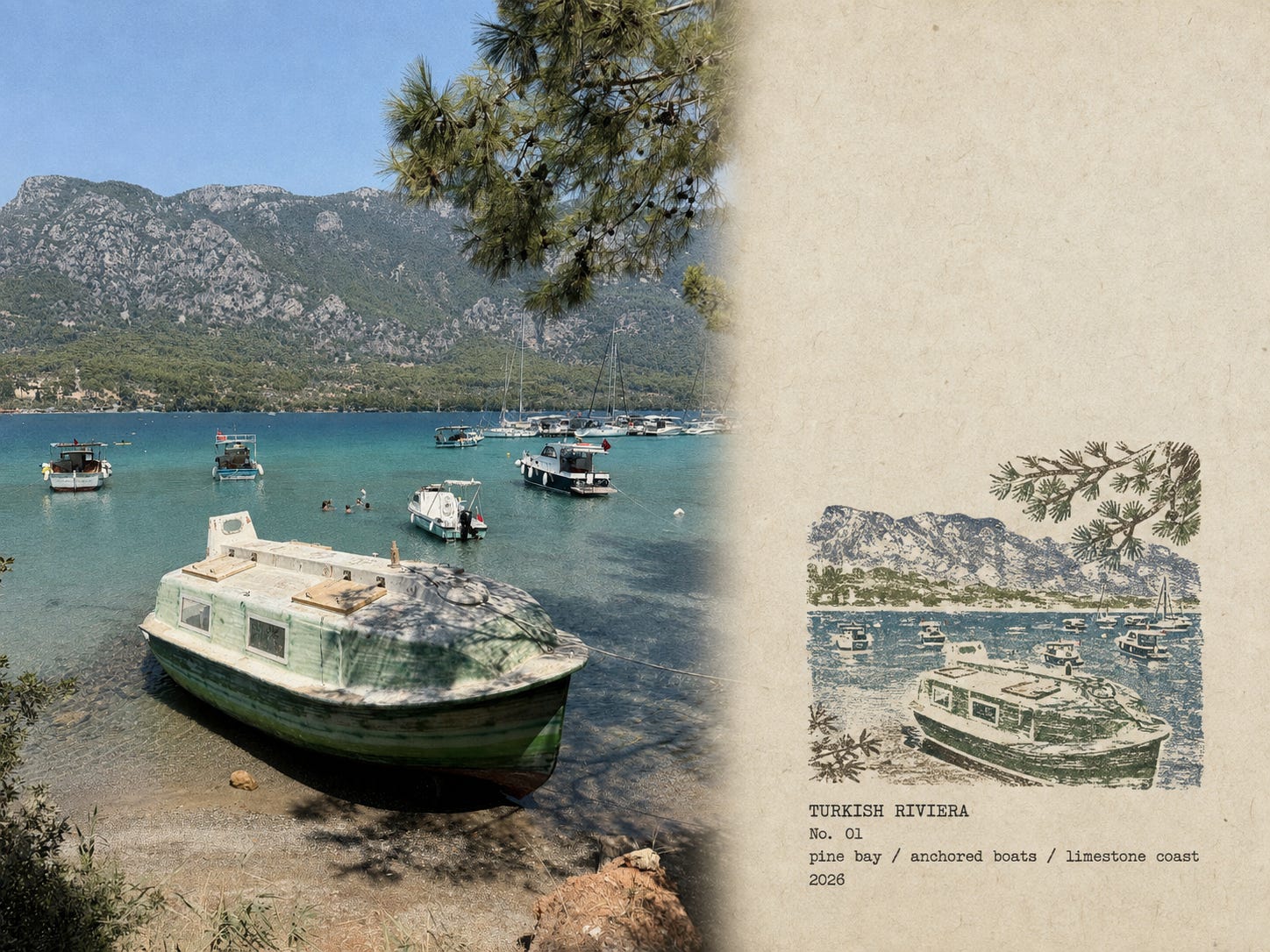
This should not be a discussion about whether that output is good or bad. I generally don’t care about vacation pictures. But I completely understand why artists may hate this. By ‘this’, I dont mean this picture, but the general trend. I would hate this if I were an artist (yes, yes, everyone is an artist).
Their work was used to train the machine and often (always?) without permission. Now the same machine can produce something that looks like their work (+ faster and cheaper), and possibly take work away from them. A lifetime of developing taste, technique, and a recognisable way of seeing can suddenly become a prompt anyone can use for twentythreenineteennine euros a month.
Art has always come from other art, other people, other lives. If learning from existing work is theft, then art has always been theft. I think art, in most cases, isn’t theft.
But obviously, with AI, and how it was trained, something feels off here.
Maybe it is the scale. You encounter a limited number of works in a lifetime. They pass through your body, your childhood, relationships, bad moods, obsessions, failures, financial struggles, and whatever strange thing happened to you a few minutes ago (maybe all of this triggered you already. free inspo, u r welcome). An LLM can absorb millions of works and imitate the visible result without living any of the life behind it.
But I think the deepest discomfort is about identity. For many artists, the work is not only something they make. It is evidence of who they became. It is deeply personal: years of looking, practising, failing, copying, abandoning things. Years of “putting yourself out there” (which I respect and look up to a lot).
And those years are the wall. The apprenticeship, the gatekeeping, the distance between the idea and the made thing. That distance is what made the craft worth having. That’s what’s collapsing.
But I also see what AI gives to people who never considered themselves artists (me, partly, at least). I stood outside that wall for years. Most of my designs stayed designs.
Then that once walled garden opened.
Suddenly nothing stands between me wanting to make something and making it. I can follow curiosity into complex topics, research, programs, images, music, writing, code, and whatever comes next. Maybe AI gives you the initial push to download Ableton and helps you walk through the basics (kick that snare). There is something beautiful in that too. To me, those experiences feel playful and childlike. You have an idea, you try it, change it, make another one. The barrier to creativity dropped immensely.
So I keep getting stuck.
One group is watching the walls around their craft and tied identity collapse. Another group is discovering that those same walls kept them outside.
I do not think the answer is that artists are simply afraid of change. I also know what happened to me. AI did not take away my desire to design. It extended it. It let me carry the work further than I could before.
Both things can be true. AI can open creation to more people while treating the people who made that opening possible unfairly (tnx). AI did not make me a designer (I already was one). AI did not give me taste. It gave my taste an output. It removed the technical boundary between my taste and its expression. imo, as the machine becomes more capable, the human contribution shifts toward conceptual clarity: knowing what you want, what to ask for, what to keep, and what feels wrong.
Maybe the stress comes from wanting one side to be wrong, because then the future would be easier to accept **.
I tend to, most of the time, understand both sides. That does not make me feel better about most things
xx
(** let’s all try not to be like this. I think this is very true for many, many of today’s trending topics, and probably the most important sentence in this short essay)
Some other things I have difficulty wrapping my thoughts around. Feel free to DM:
national flags: they are cringe as fuck and misused, but we all long for a sense of community. a strong unified nation that supports each other sounds good, at least in theory.
wolt (the delivery service): bad working conditions <> only opportunity @ a salary for many workers; „don‘t hate the player, hate the game“
airplanes: CO₂ emissions/passenger/KM in reality are really low. 1 person in a gasoline car ≈ economy flying
originally posted to swwwamo.com ___ check my other creative output here or here .